


France’s defeat in the war against Prussia in 1870, together with the capture of Napoleon III, led the French to proclaim a republic. The gap between rich and poor had been widening for years, socialists came to power, and chaos prevailed during the so-called Paris Commune of 1871. When consulted by a client, Rothschild is said to have remarked:
”Buy when there’s blood in the streets.”
What he meant, of course, was that great bargains can be made by purchasing securities cheaply when no one believes there will be a market for things such as real estate any longer.
In 1873, Europe moved from economic boom to deep depression. Bankruptcies followed one another in rapid succession, and unemployment rose dramatically. Reckless lending institutions, a construction boom, and rising land values had led many to take continued growth for granted. Cheap products from the United States outcompeted European goods, and in May the Vienna Stock Exchange crashed. British banks tightened credit, causing lending rates to soar and creating a shortage of liquidity.
Europe possessed less silver than the United States, and earlier gold discoveries had already reduced the relative value of silver. At the same time, Europe followed Britain’s lead and moved toward the gold standard. The newly unified Germany demonetized silver and adopted the gold standard. The path was now laid out for the United States to do the same.
The only question was: how?
As early as the spring of 1867, Republican Senator and member of the U.S. Committee on Finance, John Sherman, on his way to the International Monetary Conference in Paris, visited London for a meeting with bankers about abandoning silver as a means of payment. Professor Antony Sutton published a revealing letter from Rothschild to Wall Street clients in The Federal Reserve Conspiracy (1995), showing that Sherman had been in contact with Rothschild as early as four years earlier, in 1863:
”A Mr. John Sherman has written to us concerning the profits that may be made for the National Banking interests through a new act in your Congress. Apparently, the act is based on the plans formulated here last summer by the British Bankers’ Association and recommended to our American friends as something which, once enacted into law, would prove highly profitable for the banking fraternity throughout the world.”
And:
”It gives the banks almost complete control over the nation’s financial system. The few who understand it will either be so interested in its profits or so dependent upon its favor that there will be no opposition, while the great mass of the people, mentally incapable of comprehending the tremendous advantages that capital derives from this system, will bear its burdens without complaint and may not even suspect that it is contrary to their interests.”
Source: http://www.scribd.com/doc/37133348/The-Federal-Reserve-Conspiracy-Antony-Sutton
In the United States, Rothschild’s agents were financier August Belmont and Democratic Senator Manton Marble. One of the foremost economic historians of all time, Alexander Del Mar, referred to them when he wrote:
”The silver dollar was simply eliminated in order to increase the value of the gold dollar and thereby double the debt of the American people. That was the sole motive. The proof is that the same men who betrayed their party in 1868 and doubled the people’s debts by promoting the March 1869 Act also assisted in the Coinage Act of February 1873 and June 1874.”
Historian Gustavus Myers wrote in History of the Great American Fortunes:
”The extraordinary financial laws pushed through during the Civil War were merely the beginning of other laws that the bankers would have enacted in the following years, through which they rapidly and effectively increased their wealth and power, and more effectively than ever tightened the screws on the working class.”
Ordinary people had benefited from Lincoln’s government-issued, interest-free Greenbacks currency and had access to silver, but the bankers wanted complete control over the currency themselves. Their allies in Congress ensured that silver was not mentioned in The Coinage Act, which meant that it was demonetized. As a result, the monetary base—and therefore the money supply in circulation—contracted. In September 1873, the crisis struck, and it hit ordinary people brutally.
Historian Professor Scott Nelson wrote in the article The Real Great Depression:
”The long-term effects of the Panic of 1873 were perverse. For the largest manufacturing firms in the United States, with guaranteed contracts and the ability to take deductions, it was a golden age. Ordinary Americans suffered terribly.”
People such as Rockefeller, Carnegie, and others thus fared well, as did bankers like the Rothschilds. When Alphonse de Rothschild, based in Paris, died 24 years later, it was discovered that he held $60 million in American securities, as reported in a New York Times article on May 27, 1905.
The first to be affected, however, were the railroad companies, which had been financed through complex securities that few understood. The notorious railroad magnate Jay Cooke went bankrupt, and the stock market crashed along with hundreds of banks. In Great Britain, this marked the beginning of what would become a long depression for the already struggling masses.
That same turbulent year, a 20-year-old young man began studying at Oxford University. He would become deeply influenced by the ideas of John Ruskin and would soon make a name for himself.
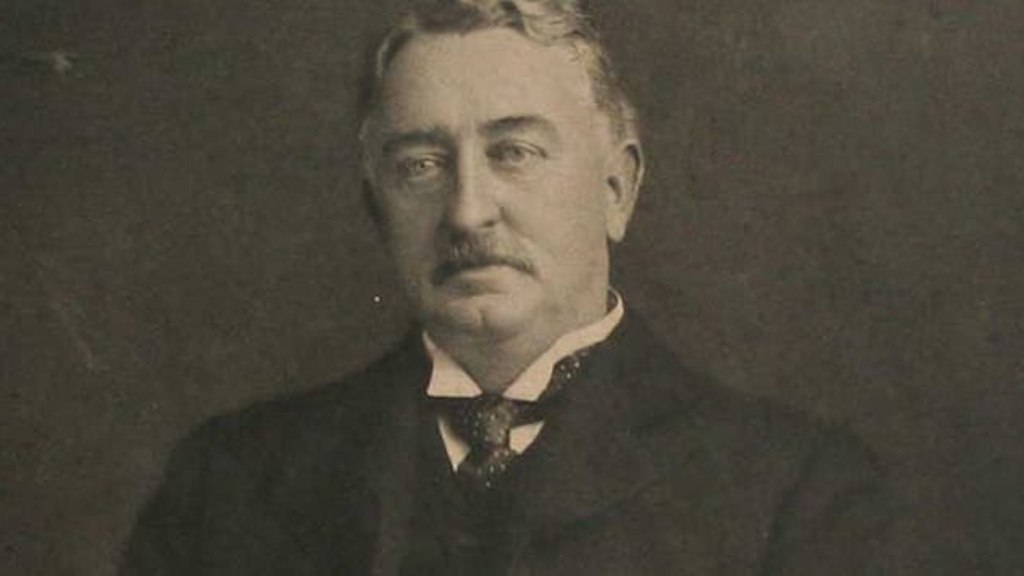
Cecil John Rhodes was born on July 5, 1853, in Bishop’s Stortford, Hertfordshire. As a young man, he suffered from poor health, and because of the English climate, he traveled to southern Africa to join his brother Herbert. Cecil and his brother sought their fortune in the newly opened diamond fields of Kimberley, and in their search for financiers they came into contact with the Rothschilds. After two years, he had accumulated a modest fortune and returned to England to study. However, his health forced him to return to Africa after only a year.
In 1877, riots broke out in the United States as a result of the economic crisis, and James Buel of the American Bankers Association wrote to a colleague about the importance of ”supporting all daily newspapers that oppose the Greenback dollar and withholding support from anyone who does not oppose the government’s printing of money.”
President James A. Garfield said in 1881:
”Whoever controls the volume of money in any country is absolute master of all industry and commerce; and when one realizes that the entire system is very easily controlled by a few powerful men at the top, one need not be told how periods of inflation and depression originate.”
Some time afterward, he was shot and killed.
That same year, Rhodes entered politics and won a seat in the Parliament of the Cape Colony. He later persuaded a tribal chief to sign over mining rights. In 1885, Rhodes worked to ensure that the British would take control of what later became known as Botswana, declaring:
”The natives are to be treated as children and denied all rights.”
In 1888, he founded the De Beers Mining Company, and that same year, through agreements with the tribal leader Lobengula, he obtained rights over the territory that was later named Rhodesia after himself. Lobengula eventually discovered that Rhodes had deceived him, and conflict broke out, during which the British used machine guns to slaughter the indigenous people. In 1890, Rhodes became Prime Minister of the Cape Colony.
Historian Brian Roberts, who examined Rhodes’s surviving archives, quotes the following revealing words in his biography of Rhodes from the first of seven wills that Rhodes began writing in 1877, known as his ”confessions of faith”:
”We are the finest race in the world, and the more of the world we inhabit, the better it is for humanity. It is our duty to seize every opportunity to acquire more territory, and we should constantly keep before us the idea that more territory simply means more of the Anglo-Saxon race, more of the best, the most human, and the noblest race the world possesses.”
And further:
”The idea glitters and dances before one’s eyes like the will of a vision that finally develops into a plan. Why should we not form a secret society whose chief purpose is the extension of the British Empire and the bringing of the whole uncivilized world under British rule, for the recovery of the United States, and for making the Anglo-Saxon race but one Empire?”
That quotation constitutes the first piece of evidence for the secret society I have described in several previous articles. It all began as follows:
On a winter afternoon in February 1891, three men met in London for a gathering that marked the beginning of a series of activities that would shake the world. The men were Reginald Baliol Brett, later known as Lord Esher, adviser to Queen Victoria, King Edward VII, and George V; William Stead, the most influential journalist of his era and editor of the Pall Mall Gazette; and, of course, Cecil Rhodes. They were later joined by the politician Alfred Milner, Rothschild, Lord Rosebery, Lord Curzon, and the future British Prime Minister Lord Arthur Balfour.
To carry out a plan of such magnitude, it was absolutely essential to have access not only to the intellectual elite but also to key positions in political, financial, and media life—something they were, in fact, able to achieve. In his will, Rhodes had explained the importance of owning the press ”because it controls the minds of the people,” and the year before, he had spoken with Stead about organizing the group ”along the lines of the Jesuit order.”
The elite’s own historian, Professor Carroll Quigley, who was granted access to their documents for two years, wrote remarkably candidly about them in Tragedy and Hope and The Anglo-American Establishment. Regarding the 1891 meeting, he wrote in part:
”The meeting in 1891 worked out the details of this secret society, and it was agreed that there should be an inner circle called The Society of the Elect and an outer circle called The Association of Helpers.”
From this, The Round Table would later take shape, and from it in turn emerged the Royal Institute of International Affairs, the Council on Foreign Relations, the Institute of Pacific Relations, the Bilderberg Group, the Club of Rome, and the Trilateral Commission. Soon, blood would be shed across the world on a scale never seen before.
Source: The Lost Science of Money: The Mythology of Money, The Story of Power, Stephen A. Zarlenga
Michael Delavante, How the oligarchs deceive the masses – Part 5