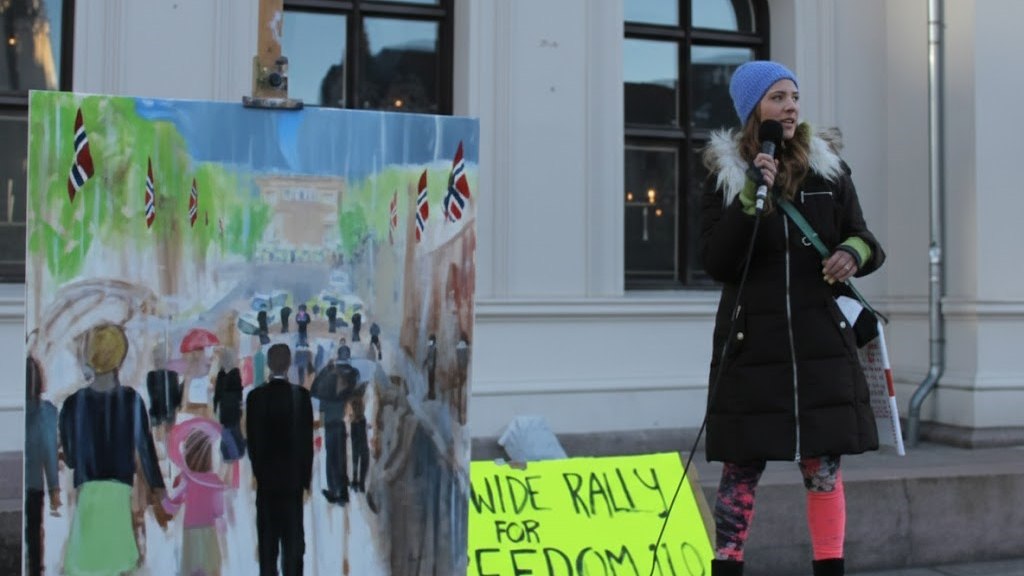
Art can say things as they are. And the history of visual art is rich with truths about difficult subjects. On February 18, 2023, I carried a painting with me to Jernbanetorget in Oslo, set it up on an easel, and climbed up onto four pallets. The painting shows a group of people mixed with Norwegian flags on Karl Johan being stopped by two police blockades on the way up toward the Royal Palace. I take the microphone and say: this is “May 17th, 2021.”
The next day, messages poured in about the work of the social-realist artist. NTB—Norway’s visual memory in news form—had kicked off a focus that would be discussed for months across all media, both mainstream and alternative.
But it wasn’t about me, and I’m not really a typical social-realist artist either, even though I’d like to think that after this painting, “May 17th, 2021,” I also master that kind of subject matter.
The painting was Christian Krohg’s “Leiv Eiriksson Discovers America.” The then-director of the National Museum had said it was colonialist and that it needed to be put in the basement.
What is one supposed to say about that? That Norwegians are Americans? And that American politics governs Norway more than we dare admit? That America is Norway and we are all colonialists who want to take over the world? That Israel is America and that the Oil Fund is the largest investor in Europe in what is happening in Palestine?
No, that was not what my painting was about. It was about the King not giving his “no” to apartheid in 2021. The people were brutally torn to opposite sides: “the vaccinated” and “the unvaccinated.” Where was the King then? The “highest” in command, the captain of the ship, was silent. The whole point of a “leader” role is to be there when one needs it most—when the decisions are so difficult that you look for a wiser voice to show the way. But no, it was dead silent. Segregation began—in families, at workplaces, in schools. The corona pass was implemented in restaurants, the Oslo Marathon, and Pride.
But we said no, and we shouted loudly, tirelessly—tens of thousands of us in Norway, millions worldwide—for three years… no to lock-downs, no to vaccine pressure, no to vaccinating children and youth, no to corona passes, no to totalitarian pandemic treaties.

The cleanup after the lockdown is moving slowly but surely, and art like the kind I brought down to Jernbanetorget helps ease the fear of touching sensitive subjects. Art doesn’t have all the answers, but that isn’t its role either. Art is exceptional at bringing forth the critical thinker, and if there was anything in short supply during the years 2020–2023, it was critical thinking. Fear does that.
That is precisely why artists need to step more into politics and human rights—living costs are rising and life expectancy is declining. Artists are often brave by nature. To turn your soul inside out for people to see, or to walk a path that is never the same as anyone else’s, requires courage.
It wasn’t as though I suddenly woke up one day wanting to create a historical painting that criticizes authorities through a historic event, when the May 17th parade was canceled for the first time since World War II.
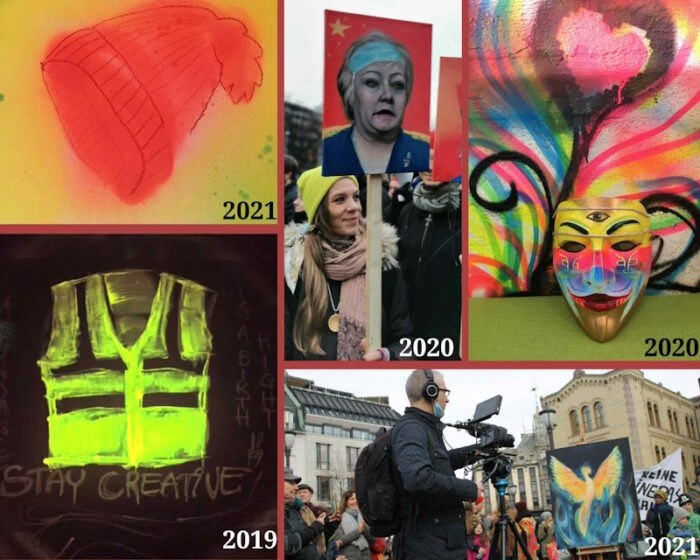
I have always had an anarchistic nature, a freedom-seeking soul. In 2019 I painted a yellow vest; in 2020 I made a more feminine version of the Guy Fawkes mask; then the Red Caps; a phoenix to mark the historic day of March 20, 2021, the first World Wide Rally for Freedom, when over 40 countries and 200 cities stood together against the corona dictatorship. Then over into the visual arts’ infamous genre of satire. The then–Prime Minister Solberg and Minister of Health Høie, the TV faces of Norway’s drastic lockdown measures. And there were dozens of homemade, painted, and written posters for demonstrations during the active fight against the corona restrictions.
A lot of cool things about art
Good for the immune system
A study from King’s College London shows that viewing art not only affects us emotionally or intellectually, but can also reduce stress and inflammation in the body.
Fifty participants either visited the Courtauld Gallery or viewed reproductions elsewhere. The researchers measured heart rate, skin temperature, cortisol, and inflammatory cytokines.
The results were clear:
● Cortisol dropped by 22% among those who viewed original art in the gallery, compared to 8% in the control group.
● IL-6 and TNF-alpha fell by 30% and 28% in the gallery group, but did not change in the others.
Dr. Tony Woods says that such stress and inflammation markers are linked to many health problems, and that original art appears to influence the — a finding the researchers describe as unique
The Image Superiority Effect
And then we have “The Picture Superiority Effect”, or the pictorial superiority effect, a term that comes from experiments showing that images have a dramatic advantage over text when it comes to human memory. When information is presented verbally, people will remember only 10% of it after three days. But if images are added, memory improves to 65%.
Images are processed more quickly, more holistically, and with greater emotional resonance

Storm
But in the art world, storms are brewing, as is the norm in many fields: jobs are being taken by AI, private and public institutions are losing financial support, and art collectors may become more withdrawn in times marked by war and unrest.
But it is all the more important to invest in voices that can contribute poetically, beautifully, directly or indirectly, to easing the world’s turbulence. I would argue that artists are inherently creators—often visionaries and problem-solvers with scientific approaches—therefore a counterforce to destructive powers.
So artists, dive deeper. Do you see the storm? Do you feel the injustice? Our task is, in many ways, to shed light on it from every possible angle. Let emotions transcend into the artistic language to illuminate the way forward.
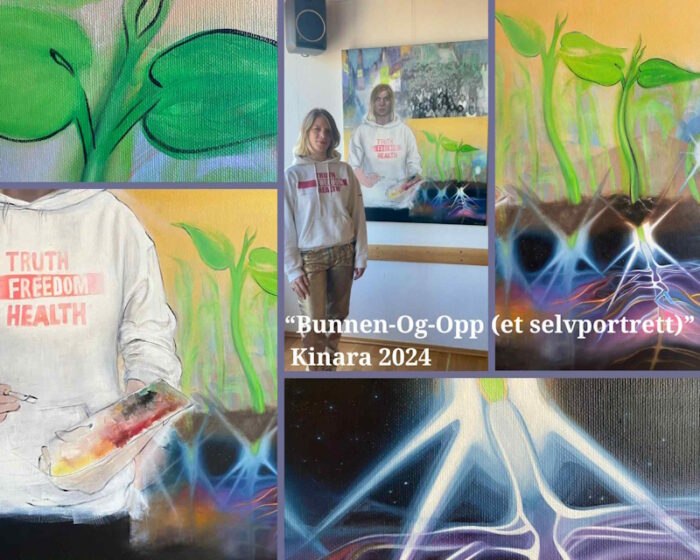
In my painting “Bunnen-Og-Opp (a self-portrait)” from 2024, I painted my tribute to the “Truth Freedom Health” movement on the hoodie in the painting, and on the side I painted plants where you can see the seed standing in cosmic soil—for grassroots cannot be cut or torn up when we stand connected across time and space.
Art is an almost untapped tool in the freedom struggle, but with massive potential. I encourage everyone with formal art education or five years in the art field to reflect on whether it is not our civic duty to create the art of our time in order to help steer the ship toward brighter days. So, artists—create rebel art now!
The picture superiority effect:

Rebel art