


Because the circle of those who make the decisions is limited, the means of decision-making are centralized, and the consequences of those decisions are enormous, the outcome of major events often rests on the decisions of identifiable groups. This great and powerful force—the combined wealth of the United States—has taken control of the functions of the government, Congress, the issuance of money, the banking system, and even the Army and Navy, maintaining a force of mercenaries who carry out its orders and protect what the text describes as its stolen wealth.
In a letter to all U.S. state governors concerning a uniform land conservation law (February 26, 1937), President Franklin Delano Roosevelt acknowledged that democracy was not functioning properly and warned that the United States was moving toward fascism:
”Unhappy events abroad have once again taught us two simple truths about the liberty of a democratic people. The first truth is that the liberty of a democracy is not secure if the people tolerate the growth of private power until it reaches a point where it becomes stronger than the democratic State itself. That, in its essence, is fascism—ownership of government by an individual, by a group, or by any other controlling private power.
The second truth is that the liberty of a democracy is not secure if its economic system does not provide employment and produce and distribute goods in such a way that an acceptable standard of living can be maintained. Both of these lessons apply here at home. In today’s society, the concentration of private power is growing to an extent unprecedented in our history.”
Statistics. To support his argument that the concentration of economic power at the time was unprecedented, the President cited statistics from the Bureau of Internal Revenue:
- 0.1% of U.S. corporations owned 52% of all corporate assets and received 50% of all corporate income. Fewer than 5% of American corporations owned 87% of all corporate assets, while fewer than 4% of all manufacturing companies accounted for 84% of total net profits.
- As early as 1929, 0.3% of the population received 78% of all dividend income.
- In 1936, 33% of all inherited wealth went to just 4% of all heirs.
Other People’s Money and How the Bankers Use It is a collection of essays by Louis Brandeis, published as a book in 1914. The book criticized the use of investment trusts to promote the consolidation of various industries under the control of a small number of corporations, which Brandeis argued suppressed competition.
Brandeis was particularly critical of investment banks that controlled vast sums of money deposited by the middle class. He pointed out that the executives of these banks routinely sat on the boards of railroad companies and major manufacturing corporations, and that they regularly directed their banks’ financial resources to benefit their own business interests. These companies, in turn, sought to maintain control over their industries by eliminating smaller competitors and penalizing innovators who developed superior products capable of challenging their market position.
Brandeis supported his arguments by discussing the actual sums of money—amounting to many millions of dollars—controlled by specific banks, industries, and industrial corporations such as J.P. Morgan. He observed that these interests had recently come to control a substantially larger share of American wealth than any previous business enterprises.
He frequently cited testimony gathered during the congressional investigation conducted by the Pujo Committee, named after Louisiana Representative Arsène Pujo, which was established to investigate self-serving and monopolistic business practices.
The book received widespread publicity and was highly praised by legal scholars. Public attention increased even further when Brandeis was nominated to the U.S. Supreme Court in 1916.
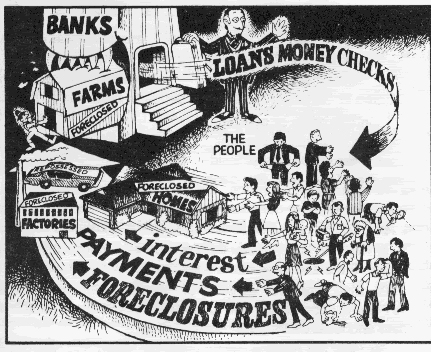
When the Federal Reserve System was introduced to an unsuspecting American public, it came with firm assurances that the era of boom-and-bust business cycles was over. The men working behind the scenes to promote the central banking concept on behalf of the international bankers sincerely promised that, from that point forward, there would be nothing but stable economic growth and lasting prosperity.
Congressman Charles A. Lindbergh Sr. made a prediction that, according to the text, would later prove correct:
”From now on, depressions will be scientifically created.”
According to the text, the international bankers had devised a way to use a central bank to create alternating periods of inflation and deflation, thereby enabling them to extract enormous profits at the public’s expense.
Having established the central bank as a tool for consolidating and controlling financial assets, the international bankers were, according to the text, ready for a major financial windfall. Between 1923 and 1929, the Federal Reserve expanded the money supply by 62 percent. Much of this newly created money was used to drive stock market prices to unprecedented heights.
At the same time that vast amounts of credit were being made available, the mass media began promoting stories about the fortunes that could supposedly be made in the stock market. According to Ferdinand Lundberg:
”To make profits on these funds, the public had to be induced to speculate, and it was induced to do so through misleading newspaper articles, often commissioned and paid for by the brokers who controlled the stock-tip services.”
During the House of Representatives hearings on stabilizing the purchasing power of the dollar in 1928, evidence was presented indicating that the Federal Reserve maintained close cooperation with the governors of the European central banks.
According to the text, the committee warned in 1927 that a major financial crash had been planned. Following a private luncheon attended by members of the Federal Reserve Board and the governors of the European central banks, the committee concluded that the international bankers were tightening the noose.
On October 24, the crisis became a reality. William Bryan describes what happened in The Unresolved Monetary and Political Problems of the United States:
”When everything was in place, the financiers in New York began calling in the call loans. This meant that brokers and their customers were forced to dump their stocks on the market in order to repay their loans. Naturally, this caused the stock market—and banks across the country—to collapse, because the banks not owned by the oligarchy were heavily involved in call loans at the time. Bank runs quickly exhausted their cash reserves, forcing them to close. The Federal Reserve did not assist them, even though it was legally obligated to maintain an elastic currency.”
According to the text, ordinary investors—including most brokers and bankers—suffered devastating losses as a result of the crash. Those within the inner circle, however, did not. They had either withdrawn from the market beforehand or had taken short positions, enabling them to reap enormous profits as the Dow Jones Industrial Average collapsed.
The text further claims that a statement by Paul Warburg served as a warning to those who understood its significance. That signal allegedly came on March 9, 1929, when the Financial Chronicle quoted Warburg as offering the following advice:
”If the orgies of unrestricted speculation are permitted to spread too far, the ultimate collapse… will bring about a general depression involving the entire country.”
On October 24, the crisis became a reality. William Bryan describes what happened in The Unresolved Monetary and Political Problems of the United States:
”When everything was in place, the financiers in New York began calling in the call loans. This meant that brokers and their customers were forced to dump their stocks on the market in order to repay their loans. Naturally, this caused the stock market—and banks across the country—to collapse, because the banks not owned by the oligarchy were heavily involved in call loans at the time. Bank runs quickly exhausted their cash reserves, forcing them to close. The Federal Reserve did not assist them, even though it was legally obligated to maintain an elastic currency.”
According to the text, ordinary investors—including most brokers and bankers—suffered devastating losses as a result of the crash. Those within the inner circle, however, did not. They had either withdrawn from the market beforehand or had taken short positions, enabling them to reap enormous profits as the Dow Jones Industrial Average collapsed.
The text further claims that a statement by Paul Warburg served as a warning to those who understood its significance. That signal allegedly came on March 9, 1929, when the Financial Chronicle quoted Warburg as offering the following advice:
”If the orgies of unrestricted speculation are permitted to spread too far, the ultimate collapse… will bring about a general depression involving the entire country.”
Louis McFadden, Chairman of the House Committee on Banking and Currency, accused international bankers of causing the stock market crash:
”It was no accident. It was a carefully contrived occurrence… The international bankers sought to bring about a condition of despair here so that they might emerge as the rulers of us all.”
At a conference held at the Roosevelt Institute in 2010, Joseph Stiglitz—former Chief Economist of the World Bank and a Nobel Prize laureate—argued that the structure of the Federal Reserve System is so rife with conflicts of interest that it is corrupt and undermines democracy. Stiglitz emphasized that the Federal Reserve Banks have clear conflicts of interest because they are, to a significant extent, governed by boards that include executives from the very banks they are supposed to supervise.
Bank for International Settlements
In 1929, the Young Committee was established to develop a program for regulating Germany’s war reparations, one of the outcomes of the Treaty of Versailles, which was drafted during the Paris Peace Conference in 1919.
The committee was chaired by Owen D. Young, founder of the Radio Corporation of America (RCA), a subsidiary of General Electric (GE). Young also served as President and CEO of General Electric from 1922 to 1939, co-authored the Dawes Plan in 1924, was appointed to the Board of Trustees of the Rockefeller Foundation in 1928, and in 1929 served as Vice Chairman of the Federal Reserve Bank of New York. When he traveled to Europe in 1929 to design Germany’s repayment program, he was accompanied by J. P. Morgan Jr.
According to the text, the committee produced the Young Plan, which ”was essentially a method of occupying Germany with American capital and mortgaging German real assets in exchange for a massive loan from the United States.” The text further claims that the Young Plan led to ”steadily increasing unemployment,” which in turn enabled Adolf Hitler to promise that he would ”eliminate unemployment”—a factor the text describes as ”the real reason for Hitler’s enormous electoral success.”
The plan came into effect in 1930, the year after the stock market crash. One component of the plan was the creation of an international settlement institution. This organization was established in 1930 as the Bank for International Settlements (BIS).
Its stated purpose was to facilitate and coordinate the payment of war reparations from the Weimar Republic to the Allied powers. According to the text, however, its secondary function was far more significant and far more secretive: to coordinate the activities of the world’s central banks.
The BIS is described as ”a bank for central banks” and ”a private organization with shareholders that performs functions on behalf of public authorities.” According to the text, these functions are conducted under strict confidentiality, with the result that the public is generally unaware of most of the BIS’s activities.
The BIS was created ”to remedy London’s decline as the world’s financial center by establishing a mechanism through which a world with three leading financial centers in London, New York, and Paris was created that could nonetheless function as a single entity.” As CFR member and mentor to Bill Clinton, Carroll Quigley, explained in Tragedy and Hope:
”… the powers of financial capitalism had another far-reaching aim, nothing less than to create a world system of financial control in private hands able to dominate the political system of each country and the economy of the world as a whole. This system was to be controlled in a feudalist fashion by the central banks of the world acting in concert, by secret agreements arrived at in frequent private meetings and conferences. The apex of the system was to be the Bank for International Settlements [BIS] in Basel, Switzerland, a private bank owned and controlled by the world’s central banks which were themselves private corporations.”
The Bank for International Settlements (BIS) was founded by ”the central banks of Belgium, France, Germany, the Netherlands, Japan, and the United Kingdom, together with the three leading commercial banks in the United States, including J.P. Morgan & Company, First National Bank of New York, and First National Bank of Chicago. Each central bank subscribed to 16,000 shares, and the three American banks subscribed to the same number of shares.” However, ”only the central banks have voting rights.”
In a letter dated November 21, 1933, President Franklin D. Roosevelt wrote the following to Edward M. House:
”The real truth … is, as you and I know, that the financial element in the larger centers has owned the Government ever since the days of Andrew Jackson—and I am not wholly excepting the Administration of W[oodrow] W[ilson]. The country is going through a repetition of Jackson’s fight with the Bank of the United States—only on a far bigger and broader basis.”
(F.D.R.: His Personal Letters, New York: Duell, Sloan and Pearce, 1950, p. 373.)
Banking Deals with Hitler
In 1940, Graeme K. Howard, an executive at General Motors, published the book America and the New World Order, in which he argued that the United States should pursue full cooperation with the Nazi regime. According to the text, Howard blamed Franklin D. Roosevelt (FDR) for causing the war in Europe and went on to argue that the fascist governments should be supported and that the United States should help build an international economic system in accordance with Nazi objectives.
According to the text, during the 1930s Germany developed a small number of dominant industrial cartels, all of which were financed by Wall Street bankers and industrialists through loans made available under the Dawes Plan and the Young Plan. These cartels, the text claims, became the financial foundation and principal source of support for the Nazi regime.
The text further states that cooperation between Nazi German industry and American industry and finance continued throughout the period, particularly involving the interests of J.P. Morgan and the Rockefeller organizations, as well as Ford and DuPont. It claims that the international banking and corporate network associated with the Morgan and Rockefeller interests ”was intimately connected with the growth of Nazi industry.” It further alleges that Standard Oil, part of the Rockefeller business empire, ”provided vital assistance to Nazi Germany’s preparations for the Second World War.”
In addition, the text argues that the Rockefeller Foundation played an important role not only in financing eugenics movements in the United States but also in promoting eugenic ideology in Nazi Germany, thereby contributing to the ideological environment that ultimately led to the Holocaust.
Hjalmar Schacht, who had served as President of the Reichsbank during the Weimar Republic, remained head of the German central bank from 1933 to 1939. He consequently became a central figure in Nazi Germany and, according to the text, one of the principal architects of Germany’s program of reindustrialization, economic recovery, and rearmament. In 1934, Adolf Hitler appointed Schacht as Minister of Economics.
Central banks across Europe began purchasing Nazi gold, which was smuggled, melted down, and re-stamped in Switzerland (in a manner the text compares to the handling of Soviet gold). According to the text, Sweden, Spain, Portugal, Argentina, Turkey, France, the United Kingdom, Poland, Hungary, and the United States all ”conducted trade with the Nazis using gold transferred through the BIS.” It states that this was carried out through cooperation among the central banks because ”the BIS engaged in gold and foreign exchange transfers with Nazi Germany through its cooperation with the Reichsbank.” The text further claims that Hjalmar Schacht used his considerable influence and ”helped place high-ranking Nazis and foreign associates on the BIS board of directors.”
According to the text, today the Bank for International Settlements (BIS) enjoys sovereign immunity, pays no taxes, and maintains its own private police force. The BIS now consists of 55 member countries, but the group of central bankers who meet regularly in Basel is said to be much smaller, with an internal hierarchy of its own.
In a 1983 Harper’s Magazine article entitled Ruling the World of Money, Edward Jay Epstein wrote that the real decisions are made within ”a sort of inner club consisting of a half-dozen or so powerful central bankers who are more or less in the same monetary boat.” Epstein continued:
”The chief value, which also seems to distinguish the inner club from the rest of the BIS membership, is the firm belief that central banks should operate independently of their home governments. Another closely related belief of the inner club is that politicians should not be trusted to determine the fate of the international monetary system.”
According to the text, BIS regulations serve only one purpose: to strengthen the international private banking system, even at the risk of national economies. It further argues that the International Monetary Fund (IMF) and the international banks regulated by the BIS operate as a unified system: international banks lend aggressively to borrowers in emerging economies, creating foreign-currency debt crises; the IMF then arrives, described by the text as carrying ”monetary viruses” in the name of sound monetary policy; finally, international banks enter as what the text characterizes as ”vulture investors,” presenting themselves as economic rescuers while acquiring national banks that the BIS has deemed undercapitalized or insolvent.
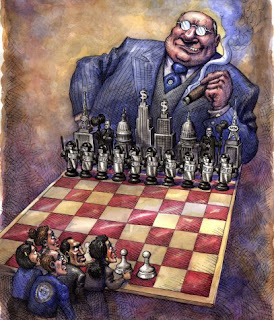
The Banking Elite’s Influence Within the United States Government
The Special Committee to Investigate Tax-Exempt Foundations and Comparable Organizations was an investigative committee of the U.S. House of Representatives that operated between 1952 and 1954. It was established by House Resolution 561 during the 82nd Congress. Commonly known as the Reece Committee, it investigated tax-exempt foundations such as the Rockefeller Foundation, the Ford Foundation, and the Carnegie foundations.
The committee’s report concluded:
”In the international field, the foundations, together with an interlocking network of certain foundations and intermediary organizations, have profoundly influenced our foreign policy and the education of the public in international affairs. This has been accomplished through extensive propaganda, by providing funds to executive officials and government advisers, by controlling much of the research in this field, and through the power of financial support. The net result of these combined efforts has been to promote ’internationalism’ in a specific sense—one directed toward ’world government’ and a diminution of American ’nationalism.'”
The report also stated that the major foundations had ”actively supported attacks upon our social and governmental system and financed the promotion of socialism and collectivist ideas.”
According to the text, the Reece Committee further asserted that the Council on Foreign Relations (CFR) was ”essentially an agency within the Government of the United States” and that its publications ”are not objective but are overwhelmingly directed toward promoting a globalist ideology.”
In 1959, James Warburg published The West in Crisis, in which he wrote:
”…a world order without world law is an anachronism…. A world that fails to establish the rule of law over nation-states will not survive for very long. We are living in a dangerous transitional period—from an era of fully sovereign nation-states to an era of world government.”
James Warburg was a banker, a member of the Council on Foreign Relations (CFR), and a founder of the United World Federalists. He was also the son of Paul Warburg, one of the principal architects of the Federal Reserve System.
In 1960, Elmo Roper (CFR), finance chairman of the Atlantic Union Committee, delivered a speech and wrote a pamphlet, both titled ”The Goal Is World Government.” In his appeal for global government, Roper stated:
”It is clear that the first step toward world government cannot be taken until we have advanced on four fronts: the economic, the military, the political, and the social.”
George William (Bill) Domhoff is a researcher and professor of psychology and sociology at the University of California, Santa Cruz. His first book, Who Rules America?, was a controversial bestseller in the 1960s in which he argued that the United States is dominated both politically and economically by an elite ownership class.
In the book, Domhoff examines where power resides in the United States. He defines three indicators of power—”Who Benefits,” ”Who Governs,” and ”Who Wins”—as the basis for determining who holds power.
At the end of Chapter 1, Domhoff briefly summarizes the main points of the book:
”Through analyses of membership in various networks, this book shows that there is a corporate community (Chapter 2) that forms the basis of a social upper class (Chapter 3). The interlocking corporate community and the social upper class have developed a policy-planning network (Chapter 4) and an opinion-shaping network (Chapter 5) that enable them to win a majority of positions in the electoral process (Chapter 6) and to formulate the policies that are of interest to them within the federal government (Chapter 7).”
In the 2007 Action Report of the Canadian Association for the Club of Rome (CACOR) (the Club of Rome was founded at David Rockefeller’s private estate in Bellagio, Italy), it was proposed that the Club of Rome should work toward a world society of a superior type, rank, and status, which ”would make the United Nations a central world government, interacting with the existing national governments (minus the present Security Council).”
Fred G. Thompson, a member of the Council on Foreign Relations (CFR), wrote in the report:
”If we do not formulate policies to halt, and then reverse, population growth, nature will automatically provide a very punitive solution. Population reduction automatically means, in plain language, a reduction in the number of people through war, disease, and famine. One possible scenario would be the introduction of birth control by a world government possessing the ability to enforce it globally.”
When Francesco Stipo, Director of the Club of Rome USA, promoted his book World Federalist Manifesto: Guide to Political Globalization at a National Press Club luncheon, he said:
”A world government is the only solution to the world’s problems, such as climate change and the global economic crisis.”
Richard Haass, current President of the Council on Foreign Relations, expanded on this theme in his article State Sovereignty Must Be Altered in a Globalized Era. According to Haass, a world government must be created and national sovereignty reduced in order to combat global warming and terrorism, just as the Club of Rome has proposed.
”Some governments are prepared to cede elements of their sovereignty in order to address global climate change,” Haass writes. ”The objective should be to redefine sovereignty for an era of globalization, finding a balance between a world of fully sovereign states and an international system characterized by either world government or anarchy.”

The exercise of sweeping emergency powers buried within Presidential Decision Directives (PDDs) can allow self-appointed officials to suspend the Constitution, declare a state of emergency, and create an executive branch dictatorship resting solely on the power of the U.S. military.
The Continuity of Government (COG) program, also known as Project 908, was activated in response to the September 11 attacks in 2001. COG was a secret program created in the 1980s, and key players in the program included Dick Cheney, Donald Rumsfeld, the CIA, and Iran-Contra figures such as Oliver North. COG ”allows” them not to follow the Constitution. The program is extra-constitutional because it creates a process for appointing a new U.S. President during a crisis that is authorized nowhere in the U.S. Constitution or federal law. COG is intended for use during crises such as a terrorist attack or when they wish to impose martial law. The COG plans are also the likely source of The Patriot Act, which was pushed through Congress five days after September 11, 2001, and the Department of Homeland Security’s Project Endgame—a ten-year plan, launched in September 2001, to expand detention camps at a cost of $400 million in 2007 alone.
Continuity of Government (COG) has been martial law in effect ever since September 11, 2001. The State of Emergency (SOE), declared by the Bush administration on September 11, 2001, and proclaimed on September 14, 2001, was repeatedly extended thereafter by President Bush, most recently on August 28, 2008. Under the cover of the SOE, Bush secretly implemented numerous extreme measures, ranging from the suspension of habeas corpus to preparations for total martial law in America, all as part of the so-called secret Continuity of Government (COG) procedures associated with the SOE. The State of Emergency was formally declared in writing on September 14, 2001, pursuant to Section 202(d) of the National Emergencies Act (50 U.S.C.). The State of Emergency has remained in full force and effect from September 11, 2001, to the present day.
Most disturbing, officials in the executive branch, under the secret provisions of a COG regime, can suppress and usurp the lawful powers of Congress and the judicial branch of the government (by force of arms if necessary) as a means of ensuring ”cooperation” within the framework of a ”unitary executive.”
Early warnings

Woodrow Wilson was an American politician (Democrat) and political scientist. He served as Governor of New Jersey in 1911 and as President of the United States from 1913 to 1921. In one of his campaign speeches, he said the following:
”Since I entered politics, men have chiefly confided their opinions to me privately. Some of the biggest men in the United States, in the field of commerce and manufacturing, are afraid of somebody. They know that there is a power somewhere so organized, so subtle, so watchful, so interlocked, so complete, so pervasive that they had better not speak above their breath when they speak in condemnation of it.
A great industrial nation is controlled by its system of credit. The growth of the nation, therefore, and all our activities are in the hands of a few men. We have come to be one of the worst ruled, one of the most completely controlled and dominated governments in the civilized world—no longer a government by free opinion, no longer a government by conviction and the vote of the majority, but a government by the opinion and duress of a small group of dominant men.”
(Woodrow Wilson, The New Freedom, Gray Rabbit Publishing, January 29, 2011, pp. 14, 185, 201.)

Theodore ”Teddy” Roosevelt was an American politician (Republican) and the 26th President of the United States from 1901 to 1909. In a speech at the Progressive Party Convention in Chicago on June 17, 1912, he said the following:
”Political parties exist to secure responsible government and to carry out the will of the people. From these great tasks both of the old parties have turned aside. Instead of instruments to promote the public welfare, they have become the tools of corrupt interests, which use them impartially to serve their own selfish purposes. Behind the ostensible government sits an invisible government enthroned, owing no allegiance and acknowledging no responsibility to the people. To destroy this invisible government, to dissolve this unholy alliance between corrupt business and corrupt politics, is the first task of the statesmanship of the day.”
(The Iowa Official Register for the Years 1915–1916, p. 349.)
In an article titled ”HYLAN TAKES STAND ON NATIONAL ISSUES,” the New York Times, in an article from March 27, 1922 (p. 3), quoted New York City Mayor John Francis Hylan:
”The warning of Theodore Roosevelt is of much concern today: the real menace of our Republic is this invisible government which like a giant octopus sprawls its slimy length over City, State and Nation. Like the octopus of real life it operates under cover of a self-created screen. At the head of this octopus are the Rockefeller-Standard Oil interests and a small group of powerful banking houses generally referred to as the international bankers.
The little coterie of powerful international bankers virtually run the United States Government for their own selfish purposes. They practically control both parties, write political platforms, make cats-paws of party leaders, use the leading men of private organizations, and resort to every device to nominate for high public office only such candidates as will be amenable to the dictates of corrupt big business.
They seek to control and often do control all sources of public information. They seek to silence every one who questions the methods by which they are enriching themselves.
These international bankers and Rockefeller-Standard Oil interests control the majority of the newspapers and magazines in this country. They use the columns of these newspapers to club into submission or drive out of public office those who refuse to do the bidding of the powerful corrupt cliques which compose the invisible government.”
In 2007, a BBC Radio 4 investigation cast new light on an important issue that has received little historical attention: the conspiracy by a group of influential power brokers, led by Prescott Bush, to overthrow FDR and establish a fascist dictatorship in the United States based on the ideology of Mussolini and Hitler.
In 1933, the highly decorated American General Smedley Butler (recipient of two Congressional Medals of Honor) was approached by a wealthy and secretive group of industrialists and bankers, including Prescott Bush, who asked him to command a rogue army of 500,000 veterans that would help stage a coup to overthrow then-President Franklin Delano Roosevelt. The conspirators operated through a front group called the American Liberty League, which included many families whose names are still well known today, including Heinz, Colgate, Birds Eye, and General Motors.
They told Butler that the American people would accept the new government because they controlled all the major newspapers. Butler went along with the group in order to determine who was involved, but later became a whistleblower and identified the principals in testimony before the House Committee on Un-American Activities.
In 1935, Smedley D. Butler spoke these words:
”I spent 33 years and 4 months in active military service as a member of our country’s most agile military force—the Marine Corps. I served in all commissioned ranks from second lieutenant to Major General. And during that period I spent most of my time being a high-class muscle man for Big Business, for Wall Street and for the bankers. In short, I was a racketeer, a gangster for capitalism… I helped make Mexico and especially Tampico safe for American oil interests in 1914. I helped make Haiti and Cuba a decent place for the National City Bank boys to collect revenues in… I helped purify Nicaragua for the international banking house of Brown Brothers in 1909-1912. I brought light to the Dominican Republic for American sugar interests in 1916. In China in 1927 I helped see to it that Standard Oil went its way unmolested. Looking back on it, I feel I might have given Al Capone a few hints. The best he could do was to operate his racket in three districts. I operated on three continents.”
In 1936, the American Ambassador to Germany, William Dodd, wrote a letter to President Roosevelt in which he stated:
”A clique of U.S. industrialists is determined to bring about a fascist state to supplant our democratic government and is working closely with the fascist regime in Germany and Italy. I have had plenty of opportunity in my post in Berlin to witness how close some of our leading American ruling families are to the Nazi regime…. A prominent executive of one of the largest corporations told me point-blank that he was prepared to take definite action to bring fascism to America if President Roosevelt continued his progressive policies. Certain American industrialists had a great deal to do with bringing fascist regimes into being in both Germany and Italy. They gave assistance to help fascism seize the seats of power, and they are helping to keep it there. Propagandists for fascist groups seek to dismiss the fascist danger. We should be aware of the symptoms. When industrialists ignore laws designed for social and economic progress, they will seek to use a fascist state when the institutions of our government force them to obey those laws.”
(George Seldes, Facts and Fascism, Progressive Press, July 4, 2009, p. 122.)
Leroy Fletcher Prouty. Col. Prouty spent nine of the 23 years of his military career in the Pentagon (1955–1964): two years with the Secretary of Defense, two years with the Joint Chiefs of Staff, and five years at Air Force Headquarters. In 1955, he was appointed the first coordinating officer between the CIA and the U.S. Air Force for covert operations in accordance with National Security Council Directive 5412. He served as briefing officer to the Secretary of Defense (1960–1961) and to the Chairman of the Joint Chiefs of Staff.
”Events of world-historic significance are planned and organized by an elitist clique composed of very powerful people who do not belong to just one nation, one ethnic group, or one major business interest. They are a power unto themselves for whom others work. Nor is this power elite of recent origin. Its roots go far back into history.”
(L. Fletcher Prouty, JFK: The CIA, Vietnam, and the Plot to Assassinate John F. Kennedy, Skyhorse Publishing, April 1, 2011, p. 334.)
Curtis Bean Dall (October 24, 1896 – June 28, 1991) was a stockbroker, banker, investor, vice-presidential candidate, and an FDR insider. In 1968, Curtis B. Dall wrote a book in which he described his experiences with the Roosevelt family and how he had come to believe that an elite hungry for political power was ruling the country from behind the scenes:
”For a long time I believed that FDR had developed many thoughts and ideas of his own that were beneficial to this country, the United States. But he had not. Most of his ideas, his political ’ammunition,’ so to speak, had been carefully manufactured for him in advance by the CFR’s international money group. Brilliantly and with great enthusiasm, like a fine artillery piece, he fired this prepared ’ammunition’ at an unsuspecting target, the American people—thus enabling him to maintain his support in the international political arena. Perhaps he copied Woodrow Wilson too closely in that he so readily fell for the intervention of the international money group and the deception of the United Nations. My feeling is that he accepted this support merely as a practical means of achieving greater personal and political power for himself.
It was not easy for me to realize that Eleanor Roosevelt, with whom I was very close for a number of years, could knowingly play a leading role in the team of internationalists at the United Nations. The United Nations is really nothing more than a vast international banking mechanism skillfully established to deliver financial and economic profit to a small group of powerful ’One World’ revolutionaries who were hungry for power and profit. The real objectives of the leaders of the ’One World’ government and their ever-present bankers are, of course, highly insidious. Through the creation and establishment of the privately owned Federal Reserve System, they have now gained full control over the money and credit machinery of the United States…”
(F.D.R. – My Exploited Father-in-Law, 1968.)
We can see ever clearer parallels with the Roman Empire, where it was said, ”All roads lead to Rome”; today we can see ever more clearly that all roads lead to the Federal Reserve banking network and the United Nations.
The real center of power is difficult to find, and this is intentional. Opposition to a particular program or initiative is often directed at some institution, while the real power brokers of the world sit securely in their skyscrapers, dividing the spoils of war and peace among themselves, in the same way as the feudal rulers of the Holy Roman Empire and other feudal rulers over the past thousand years. The only things that have changed are the sophistication and the technology.
Some nations have more power than others, or as Orwell wrote, ”All are equal, but some are more equal than others.” Those who contribute more money have more influence than those who receive it. But the doctrine of the ”redistribution of wealth,” praised by Marx and Lenin, continues to be the most effective method of luring puppet states into the power network. Easy access to credit and interest-free loans from the World Bank, IMF, USAID, and other organizations that distribute money continues to lure national leaders into a trap from which they cannot escape.
Once they have swallowed the bait, they discover the hook. And by then it is too late. They are then offered ”incentives” not to fight the system. Sometimes these incentives take the form of more aid to the nation, and sometimes they take the form of a private bank account in a remote location. The corruption of the local police is merely a microcosm of the corruption displayed among national leaders who, after seeking to attain power, discover that instead of power they occupy the position of pimps, selling their nation like a prostitute while creating personal safety nets for themselves and their families, if they can. Some succeed; others do not. The New World Order grinds relentlessly onward, crushing some, ignoring the fact that others manage to escape, yet leading each year to an ever greater centralization of power.
Also read part 1
Constitutional Republic vs. Democracy, Part 2: The global banking elite’s takeover