

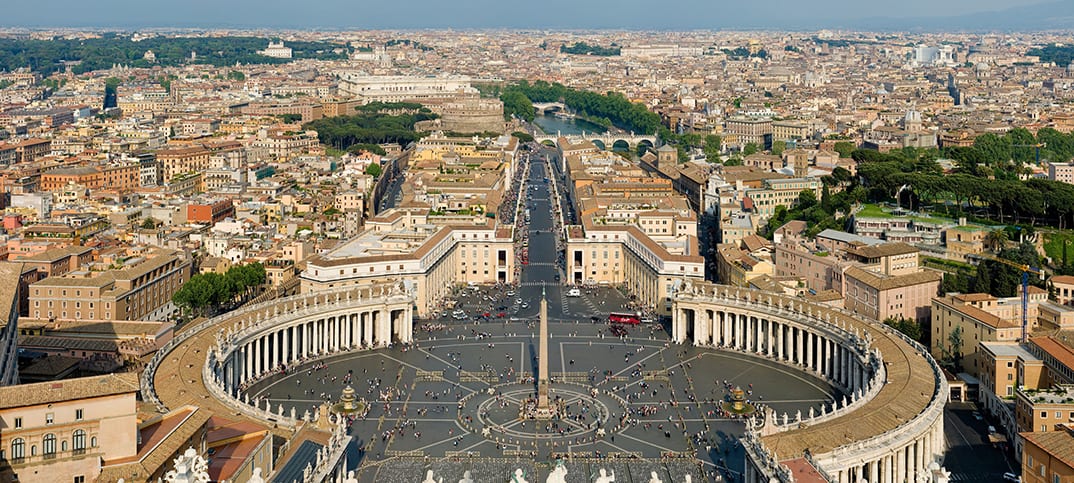
At the end of World War II, the Vatican established an escape route for Nazis, now known as the Ratline. With the help of forged passports and connections, the Catholic Church assisted thousands of Nazis, including several high-ranking officials, in fleeing to countries in South America, such as Argentina, Brazil, and Chile. In some cases, the Nazis arrived in their new countries disguised as Catholic priests, and some even went on to work as priests. In his book ”Nazis on the Run,” historian Gerald Steinacher revealed how both the Vatican, the Red Cross, and the OSS, the precursor to the CIA, helped Nazis evade justice after World War II.
Dr. Josef Mengele, the infamous ”Angel of Death” at Auschwitz-Birkenau who conducted numerous grotesque experiments on prisoners, obtained a new identity through a passport in the name of Helmut Gregor from Tramin. Erich Priebke, the Nazi regime’s liaison officer in the Vatican responsible for the murder of 335 Italian prisoners outside Rome in 1944, became Otto Pape from Latvia. Klaus Barbie, the Gestapo chief known as the ”Butcher of Lyon,” became Klaus Altmann from Romania. Others that the Vatican helped escape included Adolf Eichmann, one of the architects of the Holocaust; Walter Rauff, who invented the mobile gas chamber; and Josef Schwammberger, a camp commander in Poland accused of 3,377 murders.
Steinacher’s detailed study carefully reconstructs everything, from escape routes and refugee routes to accomplices and final destinations. He tells of how the Catholic organization Intermarium smuggled 11,000 Ukrainian SS soldiers, some of whom had worked in extermination camps, to Rimini, from where they could emigrate to other countries. An important figure in the Vatican’s efforts to help Nazis escape was OSS agent William Casey. In 1980, Casey became the head of the CIA under Reagan, and when Oliver North established the network that later became known in the Iran-Contra affair, he copied Casey’s techniques from the 1940s. Instead of Nazis, North recruited terrorists, as described in the book ”Unholy Trinity – The Vatican, the Nazis, and Soviet Intelligence” by Mark Aarons and John Loftus.
In 1951, Himmler’s daughter and a group of dedicated Nazis founded the organization Stille Hilfe, a kind of counterforce to Wiesenthal’s pursuit of Nazi criminals. The first chairman was the Catholic princess Helene-Elisabeth von Isenburg. They had secretly operated since the end of the war, collaborating with an international network of Nazis to assist fleeing Nazi criminals, and they received generous help from both the Pope and Vatican Bishop Alois Hudal, who, in 1937, sent a copy of his book ”Foundations of National Socialism” to Adolf Hitler with a personal dedication. When Bishop Hudal wrote his memoirs after the war, he gathered documents to show that Pope Pius XII had been a committed anti-Semite all his life.
In an interview with Italian journalist Emanuela Audisio in 1994, former SS officer Erich Priebke admitted that Bishop Hudal had helped him flee to Buenos Aires after the war. In 1999, a letter from Hudal to dictator and Nazi sympathizer President Juan Peron in Argentina was discovered, dated August 31, 1948, in which Hudal requested 8,000 visas for German and Austrian soldiers (Nazis). Argentine author Uki Goñi revealed, with documents he found in 2003, that the Catholic Church was deeply involved in secret networks that helped Nazis escape to Argentina:
”Peron’s government approved the arrival of Nazi collaborators as a result of a meeting in March 1946 between Antonio Caggiano, a newly appointed cardinal, and Eugéne Tisserant, a French cardinal associated with the Vatican.”
In 1962, the Congregation for the Doctrine of the Faith issued the so-called Crimen Sollicitationis, a document concerning the most serious crimes committed by Catholic priests. Paragraph 11 states that sexual crimes committed by priests should be subject to the strictest pontifical secrecy, and anyone who breaks the secrecy incurs automatic excommunication:
”When we deal with these matters, it is of the utmost importance that they be treated with the utmost confidentiality and that when the decision has been made and the decree has been issued, it be kept in a secure archive. The person who breaks the secrecy of the Holy Office, to be incurred ’ipso facto’ the excommunication reserved to the Holy See.”
In 2002, Archbishop Bernard Francis Law of Boston was forced to resign after it was revealed that he actively attempted to conceal and cover up years of child sexual abuse within the Catholic Church. Despite multiple complaints from victims of sexual abuse during the 1990s, the archdiocese refused to take action or inform parishioners that Catholic priests in their churches had been accused of child sexual abuse. Archbishop Law then moved to Rome, where Pope John Paul II appointed him as the Archpriest of the Basilica di Santa Maria Maggiore, the largest church in Rome dedicated to the Virgin Mary. In 2005, he participated in the conclave that elected the new pope.
Another high official in the Catholic Church, Bishop John B. McCormack, admitted that in 1994 he had been asked by a diocesan official to announce that a priest had been accused of child abuse but did not report it because ”it might cause a scandal.” McCormack also claimed he ”feared that an official statement would discourage people from coming forward,” even though the identities of the victims would not be disclosed. Subsequent investigations showed that McCormack’s reactions to the revelations had only served to protect the perpetrators.
When it was recently revealed that sexual abuse of Native American children at Catholic Jesuit schools in five different states in the USA had been ongoing for five decades, the Church was forced to pay out $166 million. In the last twenty years alone, 25 Catholic bishops and thousands of priests have been charged with sexual abuse of children. Professor Antoon Geels at Lund University claims that there are more sexual abuse cases within the Catholic Church than in many other environments. Geels is a professor of religious studies and says about the Catholic Church:
”With the information we have today, I think it is reasonable to say that it is over-represented.”
In his annual Christmas address in 2010, Pope Benedict said:
”In the 1970s, pedophilia was theorized as something fully in conformity with man and even with children.”
He also said:
”It was maintained — even within the realm of Catholic theology — that there is no such thing as evil in itself or good in itself. There is only a ’better than’ and a ’worse than.’ Nothing is good or bad in itself.”
Andrew Madden, a victim of sexual abuse by Catholic priests in Ireland, said:
”In the circles I moved in, it wasn’t considered normal then. It’s not normal. I don’t know what circles the pope has been moving in for the past 50 years.”
Victims of sexual abuse in the USA said that while the Church had tried to blame sexual abuse on the liberalism of the 1960s, Pope Benedict seemed to have come up with his own theory by blaming the 1970s. Certainly, there have always been and still are some grotesque organizations and crackpots trying to trivialize or even legalize child sex. Still, using that as some kind of excuse for priests’ sexual abuse is both absurd and insulting to victims and their families.
In a letter to the Irish Catholic Church, the Pope wrote that he was sorry for what had happened and criticized how the issue had been handled. The letter was a response to the fact that several priests’ sexual abuse of children had been documented in several legal investigations in Ireland. In one of them, the Murphy Commission’s report from 2009, it was stated that ”the Catholic Church systematically concealed all facts of abuse in Dublin dioceses between 1975-2004.” Many were disappointed with the lameness of the Pope’s letter, which did not call for the resignation of Cardinal Sean Brady, who participated in meetings in the 1970s where child abuse victims were forced to sign secrecy oaths.
On March 13 this year, The Times, among others, revealed that the current Pope, during his time as a cardinal in 1980, allowed a priest in Germany to continue in his ministry despite being found guilty of forcing a 12-year-old boy into oral sex. The Catholic Church believes that crimes committed by priests should be handled by the Church itself and sent the pedophile to therapy. The archdiocese confirmed that the Pope, then a cardinal, had approved a decision to allow the priest to continue working while treatment was ongoing. In 1986, the priest received an 18-month suspended prison sentence and a fine of 4,000 German marks, which can be seen as another abuse of the victim.
In May 2001, Ratzinger wrote a letter called De delictis gravioribus (concerning more serious crimes) to all Catholic bishops, in which he referred to and updated Crimen Sollicitationis. In the letter, Ratzinger explained that the Vatican must have so-called ”exclusive competence,” as reported by the Daily Mail Online: ”In other words, he demanded that all allegations of child abuse should be dealt with directly by Rome.” The Daily Mail further writes:
”Patrick Wall, a former Benedictine monk in the Vatican, says in the program: ’I discovered that I was not working for a holy institution but an institution that was entirely focused on protecting itself’.”
Most Catholics are decent people, and pedophile priests are almost certainly in the minority. Nonetheless, the foundation of Catholicism is something entirely different from what most of them believe, as this article series has shown.
Sources:
”Röda korset hjälpte SS-flyktingar,” Uppsala Nya Tidning, December 7, 2008
”The Real Odessa: Smuggling the Nazis to Peron’s Argentina,” Uki Goni, Amazon
”CURRENT LIST OF BISHOPS WITH ABUSE ALLEGATIONS”
”Pope knew priest was pedophile but allowed him to continue with ministry,” The Sunday Times, Richard Owen, March 13, 2010
”Pope ’led cover-up of child abuse by priests’,” Mail online, by EWAN FLETCHER, September 30, 2006
Article written by Michael Delavante.”